
Sighthound Off-Lead Exercise: Safe Options
· 5 min read
Sighthound off-lead exercise: balancing freedom and safety
Letting a sighthound off the lead can sound straightforward when a large field is available. Yet a fast dog interested in moving objects may suddenly stop noticing you. An open meadow is therefore not necessarily a safe exercise area. The real questions are whether you can manage your dog in that specific environment and whether off-lead access is permitted there.
Whippets and Galgos are often described as sight hunters. Movement may be a particularly strong trigger for some of them. This is a possible breed-related tendency, not a prediction about an individual dog. Some return reliably under distractions, while others may always need a securely enclosed place. Judge the animal in front of you rather than relying solely on the breed name on their documents.
Whippets, Galgos, Huskies and other dogs
Can a Whippet run off the lead? Is a Galgo safe during free exercise? Neither question has a universal answer. Some individuals enjoy long, fast runs and can accelerate suddenly. Watch for fixation, sudden bursts of speed and difficulty responding when something moves. An appropriate fence can lower the risk, provided the enclosure is genuinely secure for that dog.
The same principle applies when considering letting a Husky or Shiba Inu off the lead. Huskies belong to the Nordic sled dogs and the Shiba Inu to the Asian Spitz breeds. Both can be independent explorers. A Beagle may become absorbed in a scent, while a Dachshund or another hunting dog may follow a trail. These are cautious descriptions of possible tendencies, not rules for every animal. Experience, personality, training, motivation and the situation itself all matter.
Choosing an enclosure for fast or independent dogs
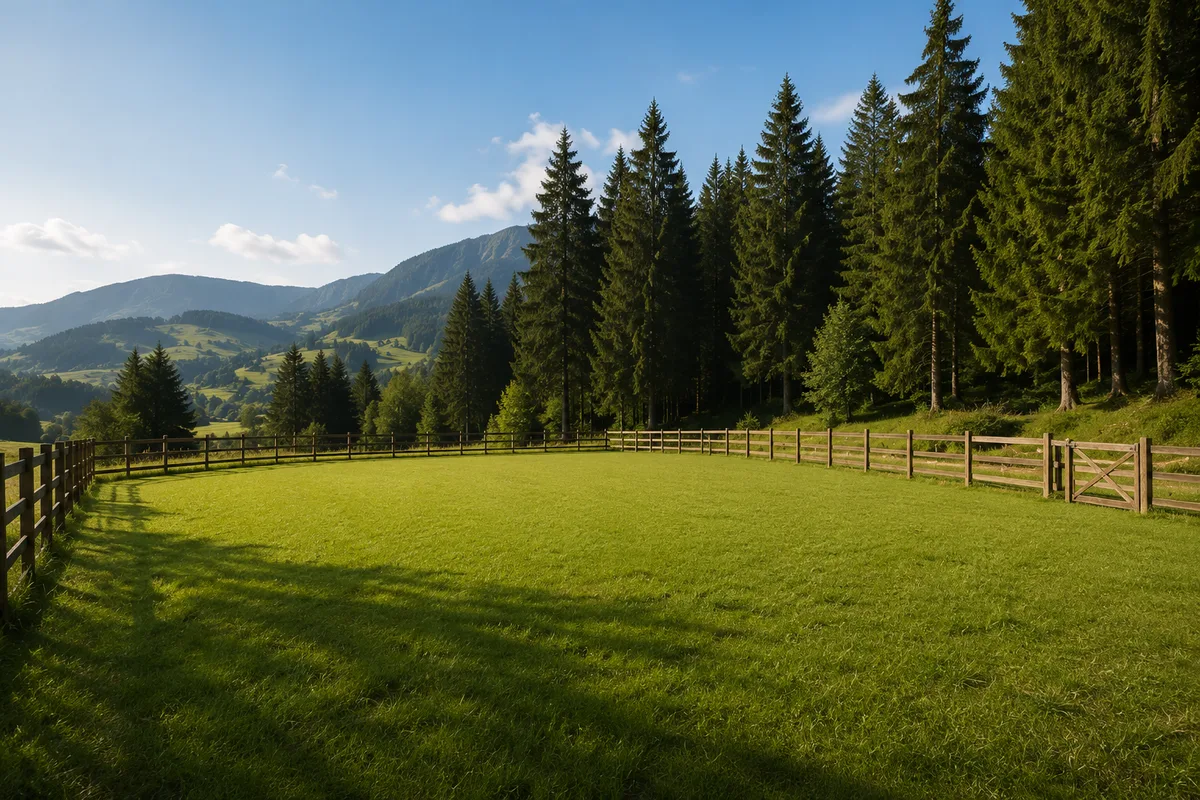
Examine the fence carefully. Its height must suit your dog's build, jumping ability and possible climbing behaviour. There is no honest universal fence height that guarantees containment for every breed. The bottom edge matters just as much. Check for gaps, loose panels and places where your dog might dig beneath the barrier. A double gate can make entering and leaving safer because the main enclosure does not open directly onto the outside.
- Walk the entire fence line before releasing your dog.
- Check that gates close securely and, ideally, that there is a double-gate entrance.
- Look for openings near the ground and signs of digging.
- Assess whether the field offers enough room for your dog's movement.
- Identify obstacles, discarded objects and potentially slippery areas.
- Check ground conditions, shade and access to drinking water.
The guide to appropriate fence heights explores further considerations. A dog running quickly needs space to slow down and turn. Attractive grass by itself does not establish that an area is suitable.
Allowing exercise without promising complete safety
Exercise is a basic welfare need. The Swiss Federal Food Safety and Veterinary Office says dogs need daily outdoor activity appropriate to their age, health and drive to move. That does not mean every dog must sprint daily, nor that a dog with strong hunting instincts should be released on unfenced land. Different activities can complement one another: walks on the lead, controlled running, scent games and unhurried exploration.
Exclusive use can be useful if your dog finds unexpected encounters stressful. Exclusivity does not guarantee safety, however. Inspect the enclosure yourself and supervise throughout the visit. Walk around calmly when you arrive instead of immediately encouraging a sprint. You can then identify hazards and give your dog time to understand the new surroundings.
Recall practice when chasing is highly rewarding
Start recall training where your dog succeeds. Reward voluntary attention and quick turns towards you. Add distractions slowly, rather than testing the hardest possible temptation. A properly handled long line can keep outdoor training safer. In a secure enclosure you may practise without lead tension. Avoid deliberately provoking a chase that your dog is not yet able to interrupt.
Separate training from management. Training develops skills. Management prevents mistakes becoming dangerous. Even a well-trained dog may respond differently when a particularly exciting trigger appears. Read prey drive and safe freedom for a fuller discussion. Impulse control exercises can also help you structure easier learning opportunities.
If your dog suddenly runs after something
Do not assume a louder shout will reliably stop a dog already chasing. Plan your environment to prevent that situation where possible. Avoid running into danger yourself. When the dog is reachable again, secure them calmly rather than punishing their return. Then assess what happened. Was the distance too small? Did you underestimate the distraction? Was there a gap in the barrier?
The next outing should address the reason for the failure instead of repeating it. You might need more distance, a different lead arrangement or a completely enclosed field. The checklist for hiring a dog field offers practical points to review beforehand.
If your dog becomes unsettled
Not every off-lead visit has to involve running. If your dog paces along the fence or becomes absorbed in animals passing outside, make the activity easier. Encourage calm sniffing, increase the distance from the trigger and end the session early if necessary. A secure space is only useful when your dog can enjoy it without becoming repeatedly overwhelmed.
A final check before the next outing
Ask whether the whole area is secure, whether your dog can squeeze underneath the fence, whether other animals are visible outside and whether the ground is appropriate. Consider weather, fitness and health too. If any important answer is uncertain, choose a safer option. Knowing your dog well is valuable, but it does not replace a physical inspection of a new environment.
If you want a field reserved for your dog without unfamiliar dogs inside, explore enclosed options through our search and check the listed details before booking.